1 cylinder cutting out

Joined
Oct 15, 2021
Messages
176
Location
NE Ohio
I'm having a problem with my NT700. It starts and runs great, no problem for hours at 70 mph, BUT if I get into a town and start hitting traffic lights, the problem occures.
The bike will idle just fine, but on acceleration, often when I get to about 1/3 throttle, one cylinder cuts out. It will come back Immediatly if I reduce throttle. If I'm gentle for maybe 700 or 1,000 feet, the problem goes away. The engine temperature has to get to the point where the fans kick in. Any other time, the bike runs perfect.

Any ideas? Anyone else had this problem and solved it? Since the problem only occures under load, I know of no way to even tell which cylinder is cutting out.

Cliff
2010 NT700 45,200 miles
 
Do some searches on the crank position sensor. Several of these have failed for riders and it is generally heat related.
Not a huge deal to change out, assuming the part is available.
Good luck.

Arknt
 
I thought about that, but crank position failure is a little different. Failure to start until cooled and things like that. It also sets a computer code.
My engine isn't quiting and always starts very easy, and no computer code. I had a crank position sensor fail a couple years ago and replaced it. Fairly easy job except for removing the muffler.

This problem is apparently heat related, probably electrical, and I have no idea what it is.

Thanks for your answer though.
 
Right now I'm thinking ignition coil, but I hate the thought of removing all that plastic without a better idea of the problem. And then I don't even know where the coils are yet.

I'm hoping someone here has had the identical problem.
 
I thought about that, but crank position failure is a little different. Failure to start until cooled and things like that. It also sets a computer code.
My engine isn't quiting and always starts very easy, and no computer code. I had a crank position sensor fail a couple years ago and replaced it. Fairly easy job except for removing the muffler.

This problem is apparently heat related, probably electrical, and I have no idea what it is.

Thanks for your answer though.
I wouldn't dismiss the crank sensor just yet It can fail as you describe. I have seen them act up both ways. The commonality however is the excessive heat when it occurs. If'n I was a betting man, my money would be on the crank sensor.

Mike
 
I wouldn't dismiss the crank sensor just yet It can fail as you describe. I have seen them act up both ways. The commonality however is the excessive heat when it occurs. If'n I was a betting man, my money would be on the crank sensor.

Mike
Sounds more coil/ sparking plug/ wire ish. There was an issue with the caps.
The engine control module on a Subaru or nt has historical memory. Think of that as a little guy in a box who counts pulses from the cam position sensor and the crank position sensor. Once he counts a few from each, he can say, "Shoot, I now know the relationship between each. I just need to count one or the other. If one breaks, like my crank position on my nt, or my cam position sensor on my old Subaru, you never know it unless you turn the engine off and try to restart it or a trouble code appears.
Easy to troubleshoot if you can get to the coils and have a can of freeze mist. You may have to shotgun.
 
quote: "Easy to troubleshoot if you can get to the coils and have a can of freeze mist. You may have to shotgun."

The only problem with that idea is that this only occures on a hot engine and only at about 1/3 throttle or above. Conditions about impossible to recreate in my garage.

I've got a 1,000 mile trip coming up with my son this weekend. When I get back, I think I'll just change both coils, plug wires, and caps. They aren't very expensive, just a bit of a pain to get to. If that doesn't work, I'll replace the crank position sensor again. After that, I'm out of ideas.

I appreciate the ideas. I wish someone else had worked through this problem before.
 
quote: "Easy to troubleshoot if you can get to the coils and have a can of freeze mist. You may have to shotgun."

The only problem with that idea is that this only occures on a hot engine and only at about 1/3 throttle or above. Conditions about impossible to recreate in my garage.

I've got a 1,000 mile trip coming up with my son this weekend. When I get back, I think I'll just change both coils, plug wires, and caps. They aren't very expensive, just a bit of a pain to get to. If that doesn't work, I'll replace the crank position sensor again. After that, I'm out of ideas.

I appreciate the ideas. I wish someone else had worked through this problem before.
Sometimes, conditions and time constraints dictate shotgunning.
In order for my meathod to work, you would have to provide for coil access before the ride. Then, when the gremlin appears, you stop, spray one coil at a time to cool it off and go down the road and see which coil gets replaced. Coils can be burried, though.

It was much simpler on my old Subaru. Open the hood and the cam position sensor was RIGHT THERE. One blast of freeze mist and the car started, happy as a clam. If you take a cam position sensor apart, its a coil of very thin laquer insulated wire. Not that much different than a 1956 Chevy ignition coil.
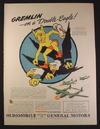
As an aside, Oldsmobile made a 37 mm Autocannon for the P38 but pilots hated it, so the govt switched to the 20 mm Hispano cannon, which Oldsmobile also helped make. The M4 37 mm was put on some P39 and P63 aircraft.
1784066633217.png
 
Last edited:
quote: "Easy to troubleshoot if you can get to the coils and have a can of freeze mist. You may have to shotgun."

The only problem with that idea is that this only occures on a hot engine and only at about 1/3 throttle or above. Conditions about impossible to recreate in my garage.

I've got a 1,000 mile trip coming up with my son this weekend. When I get back, I think I'll just change both coils, plug wires, and caps. They aren't very expensive, just a bit of a pain to get to. If that doesn't work, I'll replace the crank position sensor again. After that, I'm out of ideas.

I appreciate the ideas. I wish someone else had worked through this problem before.
If you have already replaced the OE crank sensor, that paints a different picture. It seems that only the OE sensors were problematic as I don't recall hearing of a a replacement that has failed. There was a service bulletin on the plug caps that would cause a imilar problem. Look at your plug caps. If they are marked with "NGK" then they have already been replaced. If they are faulty however you may be able to see signs of carbon tracking. Ditto on the plug wires and coils. If the insulation on the coils/wires is breaking down, you can many times use a spray bottle of water to wet the area and look for signs orf arcing. This is best done in a darkened area.

Hope this helps!

Mike
 
If you have already replaced the OE crank sensor, that paints a different picture. It seems that only the OE sensors were problematic as I don't recall hearing of a a replacement that has failed. There was a service bulletin on the plug caps that would cause a imilar problem. Look at your plug caps. If they are marked with "NGK" then they have already been replaced. If they are faulty however you may be able to see signs of carbon tracking. Ditto on the plug wires and coils. If the insulation on the coils/wires is breaking down, you can many times use a spray bottle of water to wet the area and look for signs orf arcing. This is best done in a darkened area.

Hope this helps!

Thanks for the info Mike. Yes, I've already changed the OE crank sensor, last year. When I get back, I'll check the caps, wires, and coils.
Cliff
 
Back
Top Bottom