Preemptive battery replacement

Coyote Chris

Site Supporter
Joined
Aug 25, 2011
Messages
3,674
Location
Spokane
Bike
10 Red NT 14 FJR, 17 XT
I have three bikes.
1. 2017 Suzuki V strom. Needs new battery to replace OEM one. It has an in dash volt meter so I dont even need to put on my battery tester.
2. 2014 Yamaha FJR. My maintenance records show I have never replaced the battery but that doesnt mean I didnt and didnt write it down. Starts the bike fine but I need to put the load tester on it and it isnt easy to get to. I will be touring on this bike for sure this summer.
3. 2015 VFR. I know for sure I never replaced its battery. It doesnt get coddled over the winters. I barely hit the starter and the bike fires right up.

I am tempted to replace all the batteries. Thanks to a bad welding machine at Yuasa I have had a goldwing battery burn open upon start while on tour..three times......a certain forum member and I were touring and his BMW Battery failed one miles from the Motel near bozeman.

Anyone else have catostrophic battery failure?
 
I had a couple of Bike batteries work/start strong until they did not. Was like an on off switch. One min they worked real strong, the next they were dead dead. One on my 1986 VT1100C Shadow and the other on my 2003 ST1300. Also had a jeep battery do the same. Did not know if it was the battery or a safety switch gone bad.
 
Quite happy with those:


requiring a dedicated charger though:


and those under the seat/convenient place for fast access:

 
I had a couple of Bike batteries work/start strong until they did not. Was like an on off switch. One min they worked real strong, the next they were dead dead. One on my 1986 VT1100C Shadow and the other on my 2003 ST1300. Also had a jeep battery do the same. Did not know if it was the battery or a safety switch gone bad.
Curious if they went dead when you hit the starter switch? You turn the key on and get the lights, hit the starter switch, and everything goes dark as a weld to a plate openens up.
A forum member's battery went dead just driving down the road and the engine died. The bike would start and run on my jump pack but not when it was removed.
 
A preemptive battery replacement is a bit of a tough call. I don't know that I would trust the new battery to be any better than the one installed now.
I can be a little pessimistic on buying stuff today. I bought a deer feeder battery (cheapy batt) that only lasted a couple months.
A longer trip with a battery several years old might be helping your odds by replacing it before the trip.
The battery in my Versys is the original and almost 6 years old. Seems fine so far but in back of my mind I realize it has aging going on.

Arknt
 
A preemptive battery replacement is a bit of a tough call. I don't know that I would trust the new battery to be any better than the one installed now.
I can be a little pessimistic on buying stuff today. I bought a deer feeder battery (cheapy batt) that only lasted a couple months.
A longer trip with a battery several years old might be helping your odds by replacing it before the trip.
The battery in my Versys is the original and almost 6 years old. Seems fine so far but in back of my mind I realize it has aging going on.

Arknt
Odd , is it not? A battery has lasted used and not used for 11 years in my VFR. Works perfectly. So do I replace it before a long trip? I will do a load test this weekend and see what I think. I load test all the Lith Ion jump packs I carry in my six-seven vehicles and usually replace them about every 3 years. My wife uses the heck out of hers on people at dog shows with bad batteries in their cars.
 
A preemptive battery replacement is a bit of a tough call. I don't know that I would trust the new battery to be any better than the one installed now.
Dunno... the quality/lifespan of 'conventional' batteries degraded significantly in the past 25 years...
In the 90ies my OEM YUASA lasted 5~6 years without issues... after the turn of the millennium they merely lasted one season... couldn't revive them in spring...
(environmental regs one one hand, greed for profit on the other seem to have a play in that...)

The LiFeSO4 will a) shut off before full depletion and b) are fully recharged within 30~45 minutes (vs the 12~24hrs required for AGM...)

For an NT I would not get a gel type though, they seem to increase internal resistance under load, my GF's NT700VA required 4~5 taps on the starter button to actually engage the solenoid, and the starter motor really struggled to turn over...
 
I have been riding for 61 years and over 400,000 miles. I've been lucky and only had a bad connection at the battery a couple times to tighten up. Both times I thought the battery had failed until I checked my connections. You certainly feel vulnerable when a motorcycle won't start. I just replaced my NT700 battery this spring even though it was giving no signs at all of weakening. I purchased the bike used 4 years ago and had no idea how old the "no name" battery was. I feel better about my summer rides now.

Cliff
 
I just replaced my LFP-5 battery in my FJR after nearly eight years. It still started the bike but took a bit more revolutions to start. Also I put a volt meter on it when I started the bike and the battery dropped down to 9 volts for a brief moment. I went back to a GT14B-4 sealed Absorbed Glass Mat (AGM) battery. Bike starts a lot faster. Maybe 1 to 2 revolutions of the starter. Yes I do keep my bikes on a tender when not in use at home.
 
I just replaced my LFP-5 battery in my FJR after nearly eight years. It still started the bike but took a bit more revolutions to start. Also I put a volt meter on it when I started the bike and the battery dropped down to 9 volts for a brief moment. I went back to a GT14B-4 sealed Absorbed Glass Mat (AGM) battery. Bike starts a lot faster. Maybe 1 to 2 revolutions of the starter. Yes I do keep my bikes on a tender when not in use at home.
Thanks! If I can stop work on my land tomorrow I will load test my FJR battery and check voltage drop during start. My tester has a nice analogue volt meter which is best for me for checking Voltage drop, espectially under starting conditions. I figure that while I can still physically handle the FJR, I will get my use out of it. Then I have the lightweight Vstrom and VFR. Two Wheel obsession has a nice vid on how to take out the battery. I would only add that I will stuff rags around the area insuring I wont drop bolts, etc.
 
Last edited:
Dunno... the quality/lifespan of 'conventional' batteries degraded significantly in the past 25 years...
In the 90ies my OEM YUASA lasted 5~6 years without issues... after the turn of the millennium they merely lasted one season... couldn't revive them in spring...
(environmental regs one one hand, greed for profit on the other seem to have a play in that...)

The LiFeSO4 will a) shut off before full depletion and b) are fully recharged within 30~45 minutes (vs the 12~24hrs required for AGM...)

For an NT I would not get a gel type though, they seem to increase internal resistance under load, my GF's NT700VA required 4~5 taps on the starter button to actually engage the solenoid, and the starter motor really struggled to turn over...
I would have said the exact opposite in the states. 3-4 years for a battery in the last century was pretty common. I would pickle my bikes for the winter and bring the battery in and trickle charge it in the winter. Now I am looking at three bikes...2017, 2015, and 2014, and the only one I am not sure is original is the 2014.
 
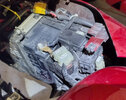
OK, I calibrated my analogue volt meter on my resistive load tester and measured the static battery voltage on my FJR. 12.7. I then did a resistive test and the volts fell to 9.2 volts. I then did a starting load test and got the same drop...9.2 volts, so I am going to order a new battery. On to the VFR.
fjr bat.jpg
OK I Checked the VFR bat...12.5 static, 10.2 under load. Even though it spins the bike over well and the bike has always fired up almost instantaneously, gonna replace it.
The Vstrom was 12 static/ 8.8 load but the bike is sluggish to start. Gonna replace it.
 
Last edited:
Back
Top Bottom