After two months of daily transfering antifreeze from the overflow bottle back to the radiator in my wifes beater 2015 Forester, Subaru released its new Gen 7 Outback and my wife and I drove two. I took a dog crate out of my 2018 Forester and put it into the Gen 7. Which has a flat floor and more room. Boom. Done.
My wife is actually reading the owners manueals. It says to never put the light duty spare on the front. I assume as this will fool with the steering. I have never had to use my subaru light duty spares. I am sold afteer my summer flat experience on the FJR and now trying the new multiple sized screw in tire plugs, coupled with the new hand held air pumps that can be run with battery or clip lead power.

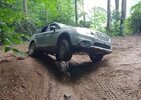
a brief description of how the Subaru "below 20 mph X mode get out of the ditch" system works. After watching youtubes of cars climbing muddy rutted hills. I am impressed.
"VDC System
With X-MODE in use, the Vehicle Dynamics Control (VDC) system provides enhanced Limited-Slip Differential (LSD) control. X-MODE enhances VDC and its limited-slip differential (LSD): when a wheel slips, brake is applied only to that wheel, shifting power to those with grip."
The whole of the VDC system uses engine torque management, gear ratio control and the ABS/Traction controls to keep the car moving, or get it to move in low traction situations regardless of what is causing the low traction. As long as one wheel is getting good traction it increases the possibility for movement, even if the other 3 have low traction.
Torque from the engine and trans moves through the center diff and to the front diff to pull the car. Torque transfer to the rear is phased in as the car moves by applying clutch pressure to the center diff. The clutch pressure is applied in phase as needed and allows for slip when the car is turning.
When a front wheel loses traction, the brake is applied to the low traction wheel, the center diff clutch gets higher pressure that locks the diff to apply more torque to the rear wheels, the engine torque management reduces torque output at the same time to help stop the slip. All rhis is done inside of seconds.
On the flip, if a rear wheel loses traction, braking is applied to that wheel, engine torque reduced, center diff locked to help provide torque to the opposing rear wheel with traction and the front diff continues to apply torque to the front wheels.
Other factors that came into play is the steering wheel direction, speed sensors, vehicle position sensors and fluid temperatures.
There is a plethora of traction loss possibilities and different degrees of traction loss. The system works so fast that there will be times you won't even know it's working; like in snow, ice, wet roads, etc. It's a combination of several systems on the car and since the drive system is symmetrical, the torque transfer from the trans, through the center diff and the front and rear diffs is equal to all wheels. This is what makes Subaru's system superior over others. Unlike a 4X4 where you have one axle shaft shorter than the other and the drivetrain has an offset from center. The length of a shaft determines the torque transfer and the longer the shaft the more torque you lose. And with systems like Ford uses in all of their brands, you can spin one wheel and the opposing wheel isn't getting torque, or the front won't get enough torque. This is because the diffs won't lock, the braking system is not responding, or it's just because Ford sucks. Dodge isn't much different. GM has a good aystem. BMW and MB are close to what Subaru has, but not quite.
My wife is actually reading the owners manueals. It says to never put the light duty spare on the front. I assume as this will fool with the steering. I have never had to use my subaru light duty spares. I am sold afteer my summer flat experience on the FJR and now trying the new multiple sized screw in tire plugs, coupled with the new hand held air pumps that can be run with battery or clip lead power.
a brief description of how the Subaru "below 20 mph X mode get out of the ditch" system works. After watching youtubes of cars climbing muddy rutted hills. I am impressed.
"VDC System
With X-MODE in use, the Vehicle Dynamics Control (VDC) system provides enhanced Limited-Slip Differential (LSD) control. X-MODE enhances VDC and its limited-slip differential (LSD): when a wheel slips, brake is applied only to that wheel, shifting power to those with grip."
The whole of the VDC system uses engine torque management, gear ratio control and the ABS/Traction controls to keep the car moving, or get it to move in low traction situations regardless of what is causing the low traction. As long as one wheel is getting good traction it increases the possibility for movement, even if the other 3 have low traction.
Torque from the engine and trans moves through the center diff and to the front diff to pull the car. Torque transfer to the rear is phased in as the car moves by applying clutch pressure to the center diff. The clutch pressure is applied in phase as needed and allows for slip when the car is turning.
When a front wheel loses traction, the brake is applied to the low traction wheel, the center diff clutch gets higher pressure that locks the diff to apply more torque to the rear wheels, the engine torque management reduces torque output at the same time to help stop the slip. All rhis is done inside of seconds.
On the flip, if a rear wheel loses traction, braking is applied to that wheel, engine torque reduced, center diff locked to help provide torque to the opposing rear wheel with traction and the front diff continues to apply torque to the front wheels.
Other factors that came into play is the steering wheel direction, speed sensors, vehicle position sensors and fluid temperatures.
There is a plethora of traction loss possibilities and different degrees of traction loss. The system works so fast that there will be times you won't even know it's working; like in snow, ice, wet roads, etc. It's a combination of several systems on the car and since the drive system is symmetrical, the torque transfer from the trans, through the center diff and the front and rear diffs is equal to all wheels. This is what makes Subaru's system superior over others. Unlike a 4X4 where you have one axle shaft shorter than the other and the drivetrain has an offset from center. The length of a shaft determines the torque transfer and the longer the shaft the more torque you lose. And with systems like Ford uses in all of their brands, you can spin one wheel and the opposing wheel isn't getting torque, or the front won't get enough torque. This is because the diffs won't lock, the braking system is not responding, or it's just because Ford sucks. Dodge isn't much different. GM has a good aystem. BMW and MB are close to what Subaru has, but not quite.